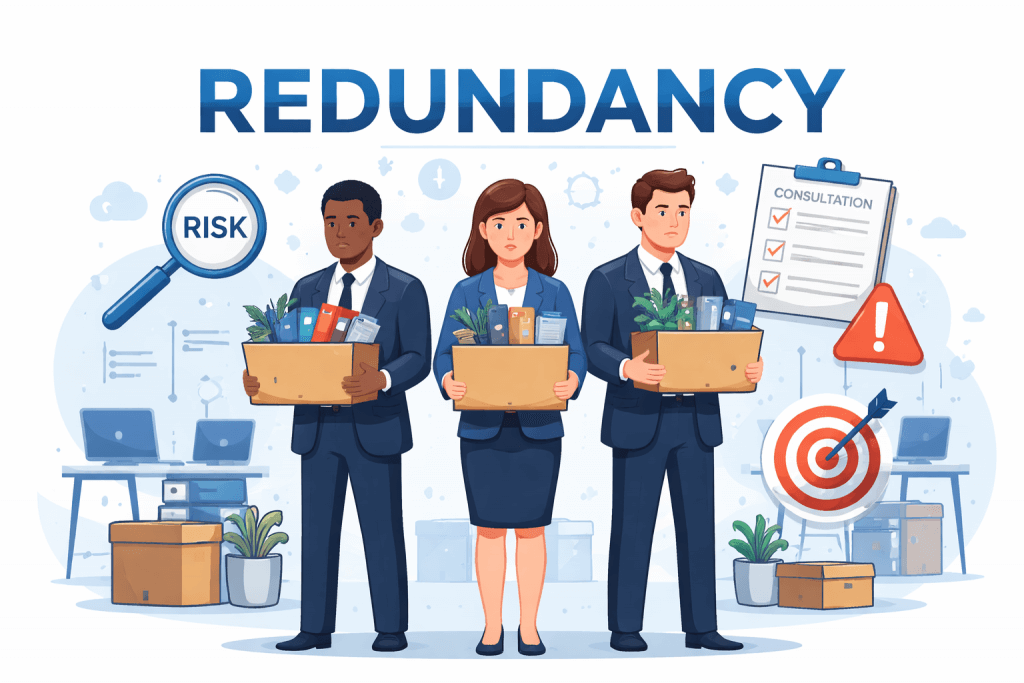
Redundancy might sound like a dry technical term, but it’s one of the most important ideas behind keeping organisations stable in uncertain times.
In simple terms, redundancy means having a backup — not because you expect failure, but because you plan for the possibility that it might happen.
And right now, redundancy planning isn’t a hypothetical. For many organisations, it’s becoming a near-term reality.
The Economic Climate Is Shifting
US tariff uncertainty is creating supply chain disruption. AI is automating roles faster than anyone predicted. Economic growth has slowed.
For HR professionals, this means one thing: redundancy consultations are coming — if they haven’t started already.
And when redundancies happen, the legal risks multiply fast.
What Is Redundancy?
At its core, redundancy is the process of removing roles where the work is no longer needed, or where the organisation needs to restructure to remain sustainable. In UK employment law, redundancy is a potentially fair reason for dismissal — but only if it is handled properly.
This could be caused by:
• A reduced need for certain work
• A workplace closing or relocating
• A business restructuring or change in operating model
• Automation replacing tasks previously done by people
Redundancy isn’t simply choosing people to leave — it is a structured process that requires clear reasoning, fair selection, meaningful consultation, and proper consideration of alternatives.
How the Redundancy Process Works
While every situation is different, a legally safer redundancy process usually follows a familiar structure:
1) Identify the Business Reason
The organisation should be able to explain why redundancies are necessary and which parts of the business are affected.
2) Define the Redundancy Pool
Employers must decide who is ‘at risk’ — often employees doing similar work — and record why the pool is set that way.
3) Choose Fair Selection Criteria
Selection must be objective, measurable, and free from bias. This is where legal risk often creeps in.
4) Consult Properly
Employees must be meaningfully consulted about the proposals, scoring, alternatives, and any suitable vacancies.
5) Consider Alternatives
Redundancy should not be the default. Employers should explore redeployment, reduced hours, hiring freezes, or other cost-saving measures.
6) Confirm Outcomes and Provide Appeal
Final decisions should be explained clearly, and employees should be offered a right of appeal.
The Cost of Getting Redundancy Wrong
A poorly handled redundancy process can result in:
- Individual unfair dismissal claims with compensation reaching £118,223 per person (and soon, potentially, unlimited).
- Discrimination claims with unlimited compensation if your selection criteria inadvertently disadvantage protected groups.
- Collective consultation failures that can cost your organisation dearly even if no one loses their job — under the Employment Rights Act it’ll soon be a penalty of six months’ pay per affected employee.
Most HR professionals have handled redundancies. But few truly understand the technical legal requirements that tribunals scrutinise.
Redundancy Planning vs Redundancy Dismissals
In IT, redundancy means having a backup system ready to take over when something fails. In HR, redundancy planning works in a similar way: you’re creating resilience so that the business can adapt when external conditions change.
But the key difference is that employment redundancies carry legal duties. You can’t simply ‘switch off’ roles — the process must be fair, transparent, and compliant.
Final Thoughts
Redundancies can be unavoidable — but legal risk is not.
Handled properly, the redundancy process protects the organisation, supports employees through change, and reduces the chance of expensive tribunal claims.
If your organisation may be entering a redundancy cycle in 2026, now is the time to pressure-test your approach: the business case, the pool, the criteria, the consultation plan, and your supporting documentation.
Because when redundancy is done right, it’s controlled and defensible. When it’s done wrong, it becomes costly — fast.
Call LBJ Consultants now to discuss how we can help guide you through the process on 07984 568523.
