
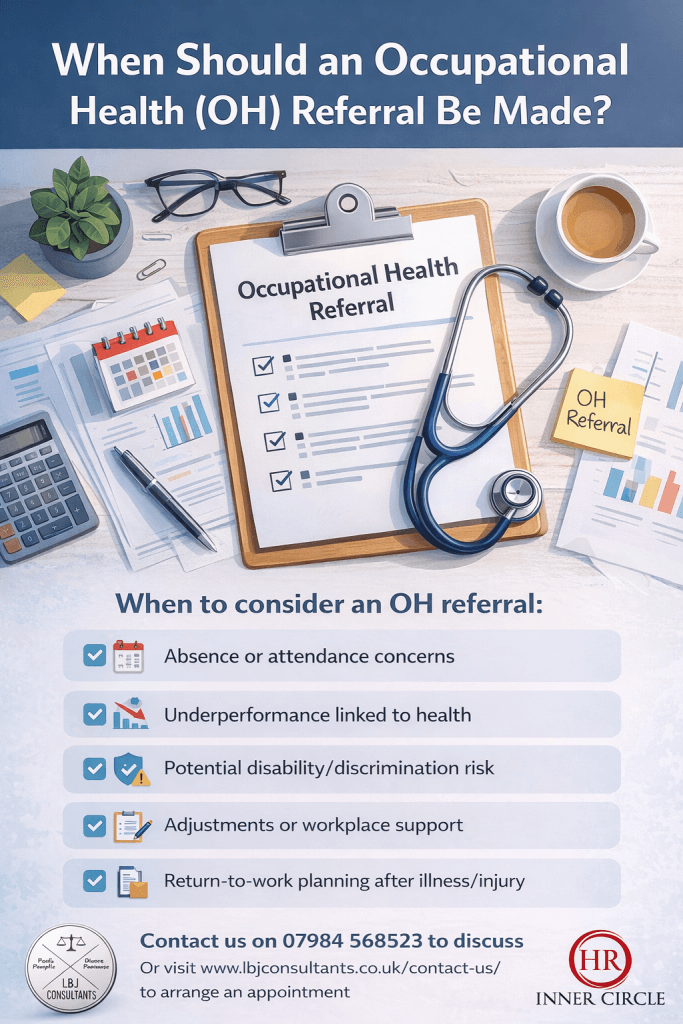
Occupational Health (OH) is one of the most valuable tools an employer can use when managing absence, capability, performance concerns, or workplace adjustments. But knowing when to refer – and how to use the advice properly – is what really makes the difference.
Knowing when to make an Occupational Health (OH) referral can be the difference between managing an absence or performance issue fairly — and exposing your organisation to unnecessary legal risk. OH referrals help employers understand whether a health condition is affecting attendance, capability or behaviour, what adjustments may be reasonable, and how long recovery is likely to take. In this guide, we explain the key triggers for referring to OH, why early referrals are often best practice, and what recent case law shows about getting it right (and what can go wrong when employers delay or ignore advice).
So, when should an OH referral be made?
1) Use OH to support decision-making (and follow the advice wherever possible)
OH should be used to inform and support management decisions, especially when absence, capability or performance may be linked to health.
In Kelly v Royal Mail Group, an employee was dismissed due to poor attendance and claimed disability discrimination. However, the tribunal found Royal Mail had acted properly because they consulted occupational health before making decisions. This demonstrates a key point: employers are expected to take reasonable steps to understand the medical picture before acting.
It’s not enough to simply obtain OH advice—you should also follow it wherever possible.
This was illustrated in cases such as C Robinson v Mind Monmouthshire, and more recently Bowen v Telefonica, where OH recommendations weren’t implemented despite being workable. Where advice is ignored without good reason, employers can face criticism for failing to explore reasonable support.
✅ Best practice: treat OH guidance as part of your evidence base and record clearly why any recommendation can or can’t be implemented.
2) OH helps protect employers from accidental discrimination risks
Many discrimination claims arise not from deliberate decisions, but from employers unintentionally failing to identify and respond appropriately to a health condition.
OH can help reduce the risk of inadvertent disability discrimination — and sometimes issues involving age or gender — by clarifying:
- Whether a condition may meet the definition of a disability
- What impact symptoms have day-to-day
- Likely timescales and prognosis
- Suitable reasonable adjustments
- Whether further specialist input is recommended
This was reinforced in Hutchinson v Asda Stores Ltd, where obtaining proper OH guidance supported an employer in managing the situation fairly and lawfully.
✅ Best practice: refer where there’s any suggestion that health is affecting work, attendance, behaviour, or performance, even if the employee hasn’t used the word “disability”.
3) Always choose a reputable OH provider with the right skillset
The quality of OH advice matters. A referral only helps if the report is competent, evidence-based, and delivered by appropriately qualified clinicians.
It’s not only employers who carry risk—OH providers also have responsibilities.
In Lee v Mitie Ltd, an OH provider (Optima) allocated a clinician who was not on the specialist register and the advice given was not considered or suitable. Cases like this highlight why provider credibility and clinical governance are essential.
Fortunately, if you’re using Smart Clinic, you can be confident your referrals are managed by clinicians who are specialist and extensively trained, ensuring advice is balanced, professional, and defensible.
✅ Best practice: confirm your OH provider has the correct qualifications, governance standards, and the expertise to advise on complex workplace health matters.
4) Refer early — and consider adjustments before starting performance management
A common mistake is to move directly into performance or disciplinary processes without checking whether a health condition is contributing.
The key message from Lynskey v Direct Line Insurance Services is that employers should refer to OH early when there are concerns about underperformance, to establish:
- whether a health condition is a contributing factor, and
- whether adjustments may enable the employee to improve
If underperformance is linked to health, the focus should shift first to reasonable adjustments and support, rather than rushing into formal performance management.
✅ Best practice: where performance dips unexpectedly or concerns are persistent, use OH to explore whether health is a factor before escalating.
5) What if an employee refuses an OH referral?
Refusal doesn’t mean you can’t act — but it does change what you can rely on.
In Elmbridge Housing Trust v O’Donogue, it was accepted that if an employee refuses to engage with medical assessment (including OH), an employer would be expected to continue managing the situation using the medical information already available.
In practice, it’s often helpful to explain the consequences clearly:
- the employer still has to manage attendance/performance
- decisions will be made without updated clinical input
- the employee may wish to reconsider once they understand this
✅ Best practice: confirm the refusal in writing and proceed using the information you already hold.
Key Takeaways: When to Refer to OH
You should consider an OH referral whenever:
- attendance becomes a concern and health may be a factor
- performance, capability or behaviour may be linked to wellbeing
- an employee requests adjustments or support
- a condition may fall under disability protection
- a return-to-work plan is needed after a long absence
- you’re considering formal action and want a clear medical picture
The earlier you refer, the more options you typically have.
Final Thoughts
We hope you’ve found these case examples helpful. We love keeping an eye on relevant tribunals and case law because they provide real insight into what good (and poor) practice looks like in real workplaces.
If you’ve come across any recent cases that stood out, we’d love to hear them — and we’re always happy to help you decide whether an OH referral is the right next step.
Call us on 07984 568523 to arrange an appointment
